
Security can feel like an overly complicated industry, and within that, you have the wide world of access control, which in itself is a separate beast entirely.
One area that often gets overlooked within access control is parking management, and specifically the signage systems that help direct drivers and manage the flow of vehicles within car parks and other controlled environments.
Variable Message Signs (VMS) are a key component of modern parking guidance systems, and in this simple guide, we break down what they are, how they work and the benefits they provide.
What Are Variable Message Signs?
Variable Message Signs (VMS), also known as dynamic message signs, changeable message signs or electronic message signs, are electronic traffic signs used to display real-time information to drivers and pedestrians.
Unlike traditional static signs that display a fixed message, VMS can be updated remotely and automatically to show different messages depending on the current conditions. This makes them an incredibly versatile tool for managing traffic flow, providing information and improving safety.
A Brief History
Variable message signs have been used in road and highway management since the 1950s. Early systems used simple bulb-based matrices to display basic text messages to motorists.
Over the decades, the technology has evolved significantly. Modern VMS units use energy-efficient LED technology, offer full colour displays and can be controlled remotely via networked software platforms. This evolution has expanded their use far beyond highways into applications such as car parks, airports, stadiums and commercial developments.
Types of Variable Message Signs
There are two main categories of VMS:
Static (fixed) VMS are permanently mounted at a specific location. They are typically used in car parks, on highways and at key junction points where ongoing information display is required. Fixed VMS units are connected to a power supply and communication network, allowing them to be updated remotely.
Moveable (portable) VMS are self-contained units that can be transported to different locations as needed. They are often used for temporary roadworks, events or emergency situations. Portable VMS units are usually battery or solar powered and can communicate via cellular networks.
Key Components of a Variable Message Sign
A typical VMS unit consists of several key components:
-
LED Display Panel: The primary visual element of the sign, using Light Emitting Diodes to display text, symbols and graphics. Modern LED panels offer high brightness, wide viewing angles and excellent visibility in all lighting conditions.
-
Controller: The on-board computer that manages the content displayed on the sign. The controller receives instructions from a central management system and processes the information to drive the LED panel.
-
Communication Module: Enables the VMS to connect to a central management platform. This can be via wired connections (Ethernet, fibre optic) or wireless (Wi-Fi, cellular, radio). The communication module allows for remote content updates and system monitoring.
-
Power Supply: Provides the electrical power to operate the sign. Fixed VMS units are typically mains-powered, while portable units may use batteries, solar panels or a combination of both.
-
Housing/Enclosure: The protective casing that shields the internal components from weather, vandalism and other environmental factors. VMS housings are typically rated to IP65 or higher for outdoor use.
-
Sensors (optional): Some VMS units incorporate sensors such as vehicle detectors, light sensors or temperature monitors. These sensors can trigger automatic content changes based on real-time conditions.
How Do Variable Message Signs Work?
The operation of a VMS system can be broken down into a simple process:
-
Data Collection: Sensors, cameras or other detection systems gather real-time data about traffic conditions, parking availability or other relevant metrics.
-
Data Processing: This data is sent to a central management system or server, where it is processed and analysed. The system determines what message should be displayed based on pre-configured rules and thresholds.
-
Content Generation: The management system generates the appropriate content, whether that is a text message, symbol, colour change or combination of elements.
-
Transmission: The content is transmitted to the VMS controller via the communication network.
-
Display: The VMS controller drives the LED panel to display the message. The content can be updated in real-time as conditions change.
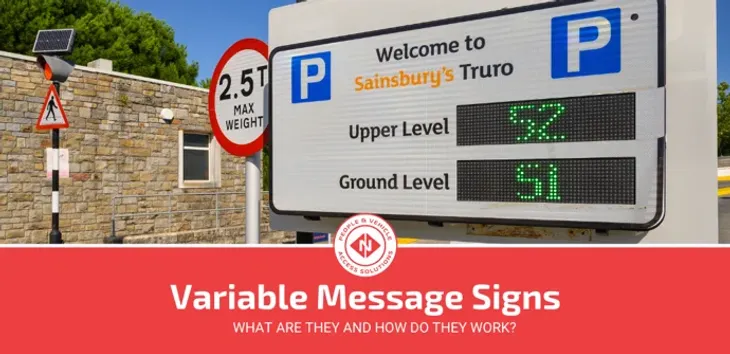
In a parking guidance system, for example, vehicle detection sensors in each parking bay communicate occupancy data to a central server. The server calculates the number of available spaces in each zone and updates the VMS displays at key decision points throughout the car park, guiding drivers to available spaces.
Benefits of Variable Message Signs
Low Power Consumption
Modern LED-based VMS units are highly energy efficient. LED technology consumes significantly less power than older bulb or fibre optic-based systems, which reduces operational costs and makes solar-powered portable units a viable option.
All-Weather Performance
VMS units are designed to operate reliably in all weather conditions. High-brightness LED panels maintain visibility in direct sunlight, rain, fog and even snow. The sealed housings protect internal components from moisture, dust and extreme temperatures.
Customisable
One of the greatest advantages of VMS is the ability to change the displayed message at any time. This allows organisations to adapt their signage to different scenarios, time periods, events or emergency situations without the cost and effort of replacing physical signs.
Range of Uses
Variable message signs are not limited to a single application. They can be used for:
- Car park guidance: Displaying available space counts and directing drivers to vacant areas.
- Traffic management: Providing speed limits, lane closures, diversion routes and congestion warnings.
- Safety messaging: Alerting drivers to hazards, weather conditions or incidents.
- Event management: Directing attendees to parking areas, entrances and exits.
- Information display: Showing travel times, public transport updates or general announcements.
Measurable Impact
VMS systems that are connected to data collection and management platforms provide valuable analytics. Organisations can measure the effectiveness of their signage strategies, monitor traffic patterns and make data-driven decisions to optimise the flow of vehicles and people.
Industries That Use Variable Message Signs
VMS technology is deployed across a wide range of industries, including:
-
Parking management: Multi-storey car parks, surface car parks, airport parking and hospital parking all benefit from VMS-based guidance systems that reduce congestion and improve the driver experience. By guiding vehicles to available spaces more quickly, VMS also helps reduce the environmental impact of parking.
-
Highways and road networks: National highway agencies and local authorities use VMS to manage traffic flow, provide real-time travel information and improve road safety.
-
Airports: VMS is used throughout airport environments, from car park guidance to terminal wayfinding and flight information displays.
-
Stadiums and event venues: Large venues use VMS to manage the influx of vehicles during events, directing drivers to available parking and providing exit routing information.
-
Commercial and retail developments: Shopping centres, business parks and mixed-use developments use VMS to guide visitors and manage parking capacity.
-
Healthcare: Hospitals and medical campuses use VMS to direct patients and visitors to available parking, reducing stress and improving the overall experience.
Summary
Variable message signs are a versatile and powerful tool for managing the flow of vehicles and providing real-time information to drivers. From car park guidance to highway management, VMS technology plays a critical role in improving efficiency, safety and the overall user experience.
As LED technology continues to advance and connectivity options expand, VMS systems are becoming more capable, energy efficient and cost-effective. For organisations looking to implement or upgrade their parking guidance or traffic management systems, variable message signs are an essential component to consider.