
When we think of access control, often what comes to mind are doors, smart cards and readers. However, access control extends far beyond the front door of a building. One of the most important, yet often overlooked, aspects of a comprehensive security strategy is vehicle access control.
Automatic Vehicle Identification (AVI) is the technology that enables vehicles to be identified and granted access automatically, without the need for manual intervention. It plays a crucial role in securing perimeters, managing car parks, streamlining logistics and improving operational efficiency across a wide range of industries.
In this guide, we explore the key components of AVI, the technologies that power it and how it integrates with wider access control and security systems.
Key Components of Automatic Vehicle Identification
An AVI system typically consists of several core components that work together to identify vehicles and manage access:
-
Vehicle Credential: This is the unique identifier associated with each vehicle. It can take the form of an RFID tag, a number plate or a combination of both. The credential is what the system uses to distinguish one vehicle from another.
-
Reader/Detection Hardware: This is the equipment that captures the vehicle’s credential. Depending on the technology used, this could be an RFID reader, an ANPR camera or both. The reader is positioned at the access point, such as a gate, barrier or entrance.
-
Access Control Panel/Server: The central processing unit that receives the credential data from the reader, cross-references it against a database of authorised vehicles and issues an access decision (grant or deny).
-
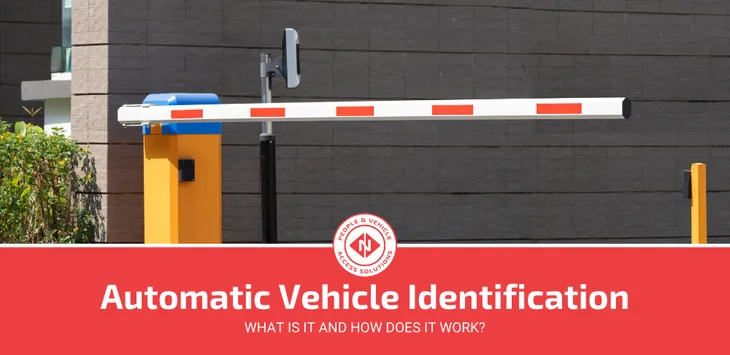
Barrier/Gate: The physical access point that is controlled by the system. Upon receiving a grant signal from the access control panel, the barrier or gate opens to allow the vehicle through.
-
Software Platform: The management interface that allows administrators to add or remove vehicles from the database, configure access rules, generate reports and monitor the system in real-time.
AVI Using RFID Systems
One of the most established and reliable methods of automatic vehicle identification is RFID (Radio Frequency Identification). RFID-based AVI systems use tags and readers to identify vehicles at a distance, enabling seamless, hands-free access.
How It Works
An RFID tag is assigned to each authorised vehicle. The tag can be a windscreen-mounted sticker, a bumper-mounted tag or a tag integrated into a vehicle’s number plate holder. Each tag contains a unique identifier that is linked to the vehicle and its owner in the access control database.
As the vehicle approaches the access point, the RFID reader emits a radio frequency signal. The tag responds by transmitting its unique identifier back to the reader. The reader forwards this data to the access control system, which checks it against the database and grants or denies access accordingly.
Vehicle Tags
RFID vehicle tags come in various form factors, each suited to different applications:
-
Windscreen Tags: Adhesive tags that are mounted on the inside of the vehicle’s windscreen. They are tamper-evident, meaning any attempt to remove and transfer the tag to another vehicle will destroy it.
-
Bumper Tags: Durable tags designed to be mounted on the vehicle’s bumper or chassis. They are particularly suited to harsh environments where windscreen-mounted tags may not be practical.
-
Number Plate Tags: Tags that are integrated into or mounted behind the vehicle’s number plate. They offer a discreet identification solution that does not alter the vehicle’s appearance.
The choice of tag depends on the application, the environment and the level of security required. In high-security installations, tamper-proof windscreen tags are often preferred because they cannot be transferred between vehicles without detection.
RFID-based AVI systems can operate at various frequencies, but Ultra-High Frequency (UHF) systems operating at 860 - 960 MHz are the most common for vehicle access. UHF provides read ranges of up to 10 metres or more, allowing vehicles to be identified while still in motion and without the need to stop.
To learn more about RFID technology in access control, explore our guide on RFID access control.
AVI and ANPR
Automatic Number Plate Recognition (ANPR) is another widely used technology for automatic vehicle identification. ANPR uses cameras and optical character recognition (OCR) software to read vehicle number plates and match them against a database.
How ANPR Works
An ANPR camera captures an image of the approaching vehicle’s number plate. The OCR software processes the image, extracts the characters from the number plate and converts them into a digital text string.
This text string is then compared against the database of authorised vehicles. If a match is found, the system grants access and the barrier or gate is opened.
ANPR Advantages
- No credential required: Unlike RFID, ANPR does not require any physical tag or credential to be attached to the vehicle. The number plate itself serves as the identifier.
- Audit trail: ANPR systems capture images of every vehicle that approaches the access point, creating a comprehensive visual audit trail.
- Visitor management: ANPR can be used to manage visitor access by pre-registering expected number plates.
ANPR Considerations
- Environmental factors: ANPR performance can be affected by poor lighting, adverse weather, dirty number plates or non-standard plate formats.
- Security: Number plates can be cloned or swapped, making ANPR alone less secure than RFID-based systems for high-security applications.
For a deeper dive into ANPR technology, read our guide on what is ANPR.
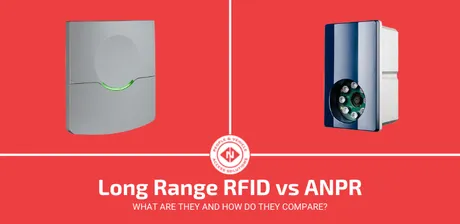
For a detailed comparison of these two approaches, see our guide on long-range RFID vs ANPR. Many organisations choose to combine ANPR with RFID for a dual-layer approach. The RFID tag provides the primary, secure identification, while ANPR serves as a secondary verification and provides a visual record. This combination offers the highest level of security and operational visibility.
Gatehouses and Vehicle Access Control
In many facilities, vehicle access is managed through a gatehouse, a staffed or semi-staffed checkpoint at the perimeter of the site. AVI technology plays a critical role in modernising gatehouse operations.
Traditional gatehouses rely on manual processes: a security officer checks the driver’s identification, verifies their purpose and manually raises the barrier. This approach is slow, labour-intensive and prone to human error.
By integrating AVI into the gatehouse, organisations can automate much of this process:
- Authorised vehicles with valid RFID tags or registered number plates are identified automatically and granted access without the need for the driver to stop or interact with security staff.
- Visitors and unknown vehicles are flagged by the system, prompting the gatehouse operator to verify their identity and purpose before granting access.
- Denied vehicles trigger an alert, and the barrier remains closed until the situation is resolved.
This hybrid approach allows the gatehouse to handle high volumes of traffic efficiently while maintaining a strong security posture. Security staff are freed from routine checks and can focus their attention on exceptions and potential threats.
People and Vehicle Tracking: An Integrative Approach
The most effective access control strategies do not treat people access and vehicle access as separate systems. Instead, they take an integrative approach that combines both under a single management platform.
An integrated people and vehicle access control system links an individual’s personal credentials (such as a smart card or mobile credential) with their vehicle credentials (such as an RFID tag or registered number plate). This creates a unified profile that provides a complete picture of the person’s movements, from the moment they enter the site in their vehicle to the areas they access within the building.
Benefits of an Integrated Approach
-
Single credential: A single RFID card can serve as both a building access credential and a vehicle access credential. The card is placed in a holder on the vehicle’s windscreen for vehicular access and used as a normal smart card for pedestrian access.
-
Comprehensive audit trail: By linking people and vehicle data, organisations gain a complete, end-to-end audit trail. They can see when a person entered the site, where they parked, which building they entered and which rooms they accessed.
-
Improved security: Integrating people and vehicle access reduces the risk of unauthorised access. For example, the system can be configured to deny building access to an individual whose vehicle has not been authorised on site, adding an additional layer of verification.
-
Operational efficiency: A unified platform simplifies administration. Adding a new employee, issuing their building and vehicle credentials and configuring their access rights can all be done from a single interface.
-
Emergency management: In the event of an evacuation or emergency, an integrated system can provide a real-time overview of who is on site and where their vehicle is located, improving roll-call accuracy and response times.
This integrative approach to people and vehicle tracking represents the future of access control. As organisations seek to create smarter, more connected buildings, the ability to manage all aspects of physical security from a single platform becomes increasingly valuable.