
Nowadays numerous technological trends are fuelling a digital revolution within the access control industry. Two of the most prominent technologies being adopted are Near Field Communication (NFC) and Bluetooth.
Both NFC and Bluetooth are wireless communication technologies that enable data transfer between devices. However, despite serving similar purposes in some applications, they have key differences that make each one suited to different use cases.
In this guide, we explore what NFC and Bluetooth are, and break down the 5 key differences between them.
What Is Bluetooth?
Bluetooth is a wireless technology standard used for exchanging data over short distances using radio waves in the ISM band, from 2.402 GHz to 2.48 GHz.
Bluetooth was originally conceived as a wireless alternative to RS-232 data cables. It can connect several devices, overcoming problems of synchronisation and is managed by the Bluetooth Special Interest Group (SIG).
Bluetooth has evolved significantly over the years. The introduction of Bluetooth Low Energy (BLE) has been a game-changer for the access control industry. BLE allows devices to communicate while consuming very little power, making it ideal for battery-operated access control hardware such as smart locks and credential readers.
In an access control context, Bluetooth enables users to unlock doors and barriers using their smartphones from a greater distance compared to NFC. This hands-free approach has made Bluetooth a popular choice for modern access control deployments.
What Is NFC?
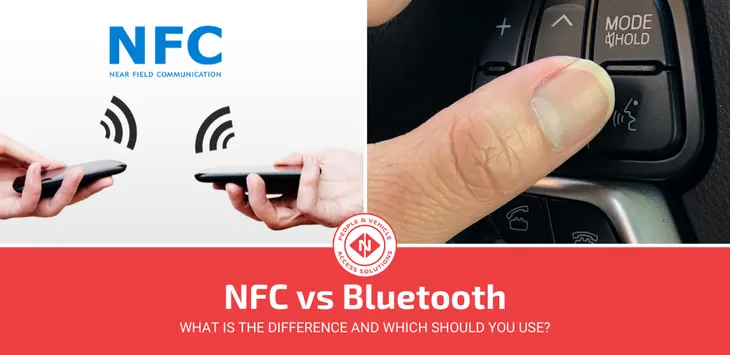
Near Field Communication (NFC) is a set of communication protocols for communication between two electronic devices over a distance of 4 cm (1.6 inches) or less.
NFC offers a low-speed connection through a simple setup that can be used to bootstrap more capable wireless connections. It operates at a frequency of 13.56 MHz, which is the same frequency as High Frequency (HF) RFID systems.
NFC is a branch of RFID technology and is found in many everyday devices, most notably smartphones, contactless payment terminals and smart cards.
In access control, NFC allows users to tap a card or smartphone against a reader to gain entry to a building, room or secure area. The short range of NFC means that the user must be in very close proximity to the reader, which provides an inherent layer of security.
5 Key Differences Between NFC and Bluetooth
1. Operating Distance
One of the most significant differences between NFC and Bluetooth is the operating distance.
NFC operates at a maximum distance of approximately 4 cm (1.6 inches). This extremely short range requires the user to be in very close proximity to the reader, essentially tapping or near-tapping the device.
Bluetooth, particularly BLE, operates at a much greater range, typically up to 100 metres in open space, although in practice this is often 10-30 metres depending on the environment and hardware.
This difference has important implications for access control. NFC is ideal for tap-based entry where a deliberate action is required, while Bluetooth enables hands-free access from a distance, which is particularly useful for vehicle access or situations where users are carrying items.
2. Technology Setup
NFC requires minimal setup. The communication between two NFC devices is almost instantaneous, taking less than 0.1 seconds to establish a connection. There is no pairing process required; the user simply brings their device close to the reader and the data exchange happens automatically.
Bluetooth requires a pairing process between devices before they can communicate. Although modern BLE implementations have simplified this considerably, the initial setup can still take several seconds. In access control applications, this pairing is typically handled through a dedicated mobile app, which may require an initial configuration step from the user.
The simplicity of NFC’s setup makes it a more straightforward technology for quick, tap-based interactions, while Bluetooth’s pairing process enables a more persistent and versatile connection.
3. Power Usage
NFC is extremely power-efficient. Passive NFC devices, such as smart cards and tags, do not require their own power source at all. They draw energy from the electromagnetic field of the reader. Active NFC devices, such as smartphones, consume very little power when performing NFC transactions.
Bluetooth, even in its Low Energy variant (BLE), consumes more power than NFC. Bluetooth requires a continuous power source and active radio transmission, which draws on device battery life. However, BLE has made significant strides in reducing power consumption compared to classic Bluetooth.
For access control hardware that needs to operate on batteries, such as wireless locks, the power consumption of the chosen technology is a critical consideration.
4. RFID Compatibility
NFC is directly compatible with existing RFID infrastructure. Operating at 13.56 MHz, NFC can read and interact with HF RFID tags and is compliant with the ISO 14443 and ISO 15693 standards. This makes NFC an excellent choice for organisations looking to upgrade their access control systems while maintaining backward compatibility with existing RFID cards and readers.
Bluetooth is not directly compatible with RFID systems. It operates on an entirely different frequency band (2.4 GHz) and uses different communication protocols. Integrating Bluetooth into an existing RFID-based access control system would require additional hardware or a dual-technology approach.
This distinction is particularly important for organisations that have invested heavily in RFID-based infrastructure and want to introduce mobile credentials without replacing their existing reader estate.
5. Security
Both NFC and Bluetooth offer robust security features, but they approach it differently.
NFC’s inherent security advantage comes from its very short operating range. The 4 cm communication distance makes it extremely difficult for an attacker to intercept the signal without being in obvious close proximity to the user. NFC also supports advanced encryption standards and secure element storage on both cards and smartphones.
Bluetooth has a much larger communication range, which increases the potential attack surface. However, BLE implements strong encryption protocols including AES-128 and secure pairing mechanisms. Modern Bluetooth access control solutions also employ additional security measures such as rolling codes and time-limited tokens.
In high-security environments, NFC’s short range may be preferred as it requires deliberate, close-proximity action from the user. In environments where convenience and range are prioritised, Bluetooth’s security features are generally considered more than adequate.
Summary
Both NFC and Bluetooth are powerful wireless technologies that are shaping the future of access control. The right choice depends on the specific requirements of your application.
| Feature | NFC | Bluetooth (BLE) |
|---|---|---|
| Operating Distance | Up to 4 cm | Up to 100 m |
| Setup Time | Less than 0.1 seconds | Several seconds |
| Power Usage | Very low / passive | Low (but higher than NFC) |
| RFID Compatibility | Yes (13.56 MHz HF) | No |
| Security | Short-range advantage | Encryption-based |
Choose NFC if you need a tap-based solution with minimal setup, backward compatibility with existing RFID infrastructure and inherent short-range security.
Choose Bluetooth if you need longer-range, hands-free access, smartphone-based credentials from a distance, or integration with smart building systems that leverage BLE beacons.
Many modern access control solutions now support both technologies, allowing organisations to offer the flexibility of NFC access control alongside Bluetooth mobile credentials in a single reader unit.