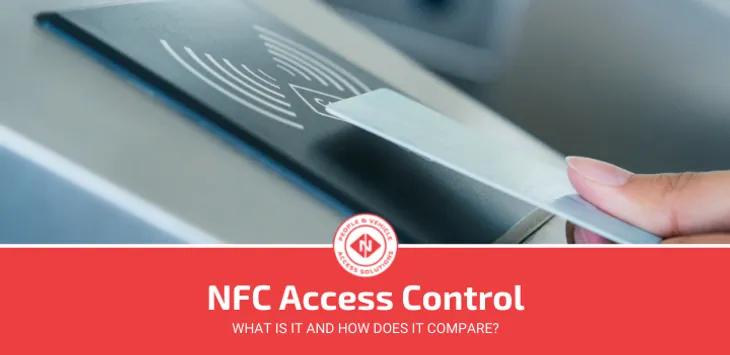

NFC-enabled solutions are quickly emerging as a universal standard in access control, due to its ability to operate on low frequency, proximity distances and provide selective access to the building.
As a branch of RFID technology, NFC is growing at a rapid rate and is being adopted across the security industry within commercial, industrial and residential buildings alike.
But what is NFC? How is it being used in access control? And what are its key benefits?
In this guide, we break down everything you need to know about NFC access control.
What Is NFC Technology?
Near Field Communication (NFC) is a set of communication protocols that enable two electronic devices to establish communication by bringing them within close proximity of each other, typically no more than 4 cm (1.6 inches).
NFC operates at a frequency of 13.56 MHz and can transfer data at rates up to 424 kbps. It is a branch of High Frequency (HF) RFID technology and its standards and protocols are based on existing RFID standards including ISO/IEC 14443, FeliCa and ISO/IEC 18092, as well as those defined by the NFC Forum.
Unlike RFID, NFC utilises only an alternating magnetic field, meaning that no power is emitted in the form of radio waves. This prevents interference from occurring between similar devices or any radio communications operating at the same frequency.
NFC tags contain data and tend to be read-only. These tags can securely hold personal data, with memory ranging between 96 and 8,192 bytes — giving NFC devices a larger storage capacity than standard RFID tags, which typically carry only simple ID information.
One important distinction is that NFC can only read one tag at a time, whereas RFID readers can scan multiple tags simultaneously. This makes RFID better suited to environments with many trackable components, while NFC excels in secure, one-to-one interactions.
The technology is found in a wide range of everyday devices, most notably smartphones, tablets and certain smart cards.
Active vs Passive NFC
There are two modes of NFC communication: active and passive.
Active NFC devices can both send and receive data. They have their own power source and can communicate with other active devices as well as passive devices. Smartphones are the most common example of active NFC devices. All active NFC devices can work in one or more of the following operating modes:
- Card emulation — enables devices such as smartphones to act as a smart card, allowing users to tap their phone to enter a building or other secured access point.
- Reader/writer — enables devices to read data stored on tags embedded in access cards or key fobs.
- Peer-to-peer — enables two NFC devices to communicate with each other and exchange data. In this mode, a device can act as both a reader and a tag, making NFC a flexible solution for businesses.
Passive NFC devices, such as NFC tags and smart cards, do not have their own power source. Instead, they are powered by the electromagnetic field generated by an active NFC device when it comes into close proximity. The passive device then uses this energy to send data back to the active device.
In the context of access control, both active and passive NFC play an important role. A smartphone (active device) can emulate a card credential, while an NFC smart card (passive device) can store access credentials that are read by an NFC-enabled reader.
What Is NFC-Enabled Access Control?
NFC-enabled access control is a system that uses Near Field Communication technology to grant or restrict access to a building, room or secure area.
Instead of relying on traditional methods such as keys, PIN codes or magnetic stripe cards, NFC access control allows users to gain entry by simply tapping an NFC-enabled device, such as a smart card or smartphone, against a compatible reader.
NFC and Smartphones
One of the most significant developments in NFC access control is the use of smartphones as access credentials.
With NFC built into most modern smartphones, users can store digital access credentials on their device and use it to unlock doors, gates and barriers, just as they would with a physical card or fob.
This approach offers several advantages. Users always have their phone with them, reducing the risk of lost or forgotten credentials. It also simplifies the management of access rights, as credentials can be issued, updated or revoked remotely without the need to distribute physical cards.
Many access control systems now support mobile credentials through dedicated apps, allowing facility managers to manage access from a centralised platform. To understand the hardware that makes this possible, see our guide on how NFC readers work.
Benefits of NFC Access Control
Convenience
NFC access control offers a seamless and intuitive user experience. Users simply tap their card or smartphone against the reader to gain access, there is no need to fumble with keys, remember PIN codes or swipe a magnetic stripe.
Enhanced Security
NFC operates at very short range (typically less than 4 cm), which significantly reduces the risk of interception or relay attacks. Additionally, NFC smart cards can support advanced encryption protocols, making cloning and unauthorised duplication far more difficult compared to legacy proximity technologies.
Mobile Credentials
As discussed above, the ability to use smartphones as access credentials is a major benefit. This reduces the dependency on physical cards and fobs, lowers replacement costs and allows for remote credential management.
Easy Integration
NFC technology is compatible with a wide range of existing access control infrastructure. Many modern smart card readers support NFC alongside other technologies, making it straightforward to upgrade from legacy systems without a complete overhaul.
Cost-Effective
While the initial investment in NFC-compatible hardware may be slightly higher than basic proximity systems, the long-term cost savings are significant. Reduced card replacements, lower administrative overhead and the option to use mobile credentials all contribute to a lower total cost of ownership.
Drawbacks of NFC Access Control
Limited Read Range
NFC’s short operating range of approximately 4 cm is a double-edged sword. While it enhances security, it also means that users must be in very close proximity to the reader. For applications where hands-free or long-range access is needed, such as vehicle access control, RFID access control solutions operating at higher frequencies may be more appropriate.
Device Dependency
When using smartphones as credentials, the system becomes dependent on the user’s device having sufficient battery life and NFC functionality enabled. If a phone runs out of battery, the user could be locked out.
Compatibility
Not all smartphones support NFC, and those that do may implement it differently across operating systems. This can create inconsistencies in the user experience and may require additional configuration or supported device lists.
Infrastructure Requirements
Implementing NFC access control requires NFC-compatible readers and, in some cases, updates to backend access control software. Organisations with large estates of legacy readers may face higher upfront migration costs.
NFC vs RFID: 5 Key Differences
On the surface, NFC and RFID can seem very similar — both are wireless, contactless technologies used in access control. However, there are five key differences that set them apart and determine which is best suited to a given application.
1. Reading Range
NFC operates at very short range, typically less than 4 cm, which is why it is often described as a proximity technology. RFID, on the other hand, can read tags at distances of up to 10 metres, making it the preferred solution for vehicle identification and access.
2. Communication
NFC is capable of two-way communication, enabling advanced applications such as card emulation and peer-to-peer data exchange. Standard RFID communication is typically one-directional, with the reader interrogating the tag.
3. Speed
Only one NFC tag can be read at a time, whereas RFID readers can scan multiple tags simultaneously. This means RFID is often better suited to environments with a high volume of trackable components, such as asset management in a manufacturing facility or tracking fast-moving vehicles.
4. Data Storage
NFC devices can store and transmit multiple types of data, with tag memory ranging from 96 to 8,192 bytes. RFID tags typically carry only simple identification information. This makes NFC better suited to environments where payment details, membership information or ticketing data needs to be transferred.
5. Cost
Due to its reduced reading range and simpler infrastructure requirements, NFC-based readers tend to be more affordable than long-range RFID solutions. This makes NFC a strong option for organisations seeking a high-quality access control solution on a tighter budget, while RFID commands a premium for its extended range and multi-tag capabilities.
Summary
NFC access control represents a significant step forward in the security industry. Its combination of convenience, enhanced security and the ability to leverage mobile credentials makes it an attractive option for a wide range of applications.
However, like any technology, it has its limitations. The short read range, device dependency and potential compatibility challenges should be carefully considered when evaluating whether NFC is the right solution for your access control needs.
For many organisations, NFC works best as part of a multi-technology approach, complementing other solutions such as RFID and Bluetooth to create a comprehensive and flexible access control system.